These days, pay transparency is a hot topic among HR and compensation professionals. There’s also been some interesting developments from Buffer’s employer driven approach of sharing everyone’s pay with all employees to a Google employee taking it into her own hands. Yet, it’s still somewhat controversial to discuss pay strategy openly with employees at most companies. The tide may be turning, however, as employees increasingly expect more transparency around compensation and employers look to adopt more open pay practices in response.
Pay transparency doesn’t have to be an all or nothing approach where everyone knows everyone else’s salary. Rather, we believe transparency is a spectrum. It’s the degree to which an organization is willing to discuss its overall pay practices. Pay transparency is a lot more than just the dollar amount an employer pays each employee. It’s also being more open about how pay was determined and providing an explanation of the company’s pay grades. It’s crucial to recognize that certain industries and organizations have a different level of tolerance for pay transparency, so it’s important to get the approach right.
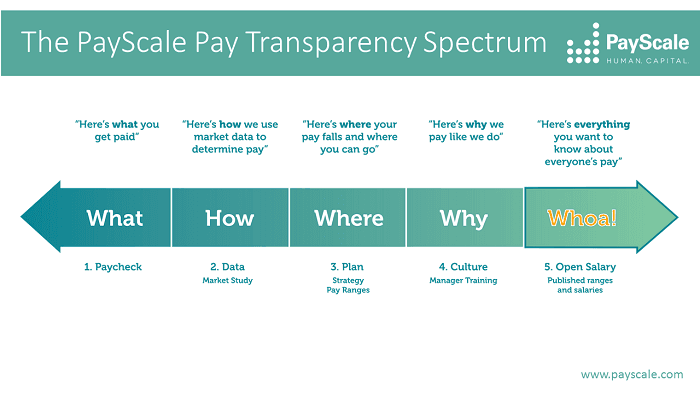
At PayScale, we’ve identified five levels of pay transparency so companies can determine where they are currently and then establish a plan for getting to the place they want to be. Here’s a description of the five transparency levels:
- Paycheck, or “Here’s what you get paid.” At this level of transparency, organizations tell employees what they get paid and little else. This represents a missed opportunity to talk with employees about what’s working well, job expectations, development opportunities, and what matters most to an employee.
- Market data, or “Here’s how we use information to set pay.” Organizations get market data for some critical roles at this level. They may attempt to get data for all jobs, however, the data may be unreliable or be missing some aspects of a full market study such as compensation strategy or alignment to organizational objectives. While managers may have some data, they don’t always have the answers to an employee’s follow up questions.
- Comp plan, or “Here’s where your pay falls in the range.” From this point of the spectrum on, companies are considered transparent. These companies have fleshed out a comp plan with philosophy strategy, ranges, policies, etc. Employees learn where their pay falls relative to the range and get a sense of potential movement in the organization.
- Culture/alignment, or “Here’s why we pay like we do.” At this level, organizations use their comp plan as an extension of their culture, aligning their talent strategy to accomplish business objectives. Managers at this level are willing to openly discuss the rationale for pay decisions.
- Open salary, or “Here’s everything you want to know about everyone’s pay.” Organizations that have open salary policies, or ‘radical transparency,’ often share — internally or externally — all ranges as well as actual salary information for every employee.
There are many reasons for increasing pay transparency at an organization that is currently at the lower end of the spectrum. Research shows that transparency drives deeper engagement with employees who perceive a ‘fair and transparent pay practice’ and these same employees are more satisfied at work. This really matters because more engaged employees have a greater positive impact on the bottom line at any organization. In addition, millennials have grown up with greater access to information, so this large segment of the workforce not only wants, but expects more transparency from their employers. And finally, people really have no idea if they’re being paid fairly. The same research shows that two-thirds of employees paid at or above market value actually think they are underpaid and could be a flight risk. So paying a prized employee more money may not keep them around if the employer is not actually talking about their pay.
To start, employers should decide how much pay transparency is right for their organization and then develop a plan for making this cultural shift. It’s important to get things in order before moving to more open pay practices to avoid creating chaos. Many HR managers and comp professionals will first talk to their executive team to articulate the benefits and get them on board with the new approach. Companies should also set managers up for success by training them to have conversations with employees about their compensation and addressing questions about pay.
Employers shouldn’t wait too long to join this movement because it’s a growing trend and companies that don’t start talking about pay may soon be left behind in the battle for talent.
This article was first published on Compensation Today, the PayScale blog.