When you researched your last holiday, did you look to see what other people had said about the hotel before you booked it? When you made a reservation at that Italian restaurant last weekend, did you do so on the back of a friend’s recommendation or the customer reviews you had read about it? Or when you were last searching for that big ticket item, did you check out which brands were most highly rated by your peers?
For the vast majority of us, the answer to each of these questions will be ‘yes’. In the past couple of years, we’ve become a nation of review-led consumers – we make our own purchasing decisions based on the experiences, opinions and thoughts of other users. In fact, 90% of consumers read online reviews before visiting a business, while 88% trust online reviews as much as personal recommendations from friends and family. TripAdvisor, Amazon, eBay ratings, Which?, Yelp, TestFreaks, Angie’s List – there are now a plethora of sites solely focused on gathering our opinions on the things we buy, the services we use and companies we encounter.
So, it should come as no surprise when I tell you that this nation of review-led consumers are moving beyond just seeking advice for their consumer goods, and starting to place more emphasis on the opinions of others when it comes to making decisions about where to work.
Yes, the Millennial generation is now being dubbed the “Glassdoor Generation.”
 “In their world (our world too but we didn’t come of age in it) everyone has an opinion, everyone is a reviewer, everybody gets a say,” says Dave Foxall of HRMS World. Just like we do when we’re looking for the best place to stay or eat, a whole generation of job seekers are now using what other people say as an aid in their decision-making process when it comes to choosing which companies to work for.
It’s important to sit up and pay attention to this growing trend because you no longer have sole control over what’s being said about your company and by whom. You can do your damnedest to create the world’s best careers site or the most enticing job ads, but all it takes to destroy your reputation as an employer is one derogatory comment in the wrong place at the wrong time.
“So, not only is every brand on the planet potentially held hostage by the viral tweet of a disgruntled customer, but employers are increasingly finding that their employees (and ex-employees) are not only heard, but listened to,” continued Foxall. And we’re adding rejected/unsuccessful candidates to that list too.
So, what can recruiters do to ensure we don’t leave ourselves open to criticism on sites like Glassdoor and across social media, that could potentially damage our employer brand and as a result, our reputation as an employer?
1. Treat Your Employees Like Customers

Andrea Huckett collecting Saint-Gobain’s award for TOP EMPLOYER 2015.
“Not only can employees now share their views on Facebook, Twitter and LinkedIn, sites like Glassdoor are also growing in popularity, giving people the chance to review their workplace. If employees feel valued and well treated, they will share their experiences online. This is why employees can be the best advocates a brand can have,” says Andrea Huckett, Head of Career Management at Saint-Gobain UK, Ireland and South Africa. “Employees should be treated like customers – after all, customers wouldn’t stay around for long without committed and engaged employees. Employees who feel respected and trusted to do a good job are more likely to advocate your brand, spreading positive messages across their own personal networks, helping to build brand awareness and attract new talent.”
Do not underestimate the strength and reach of your employees personal networks. The following illustration compares the maximum achievable social audience of an average Fortune Global 100 company to the maximum achievable social audience of its employees:
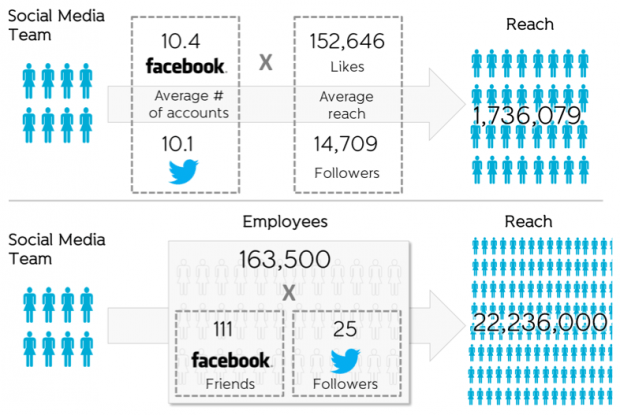
While the average Fortune 500 company can reach just over 1.7 million people with their own social networks, the average achievable social audience of all of their employees is a whopping 22.2 million people! If the messages they’re sharing with that massive audience are positive that’s fantastic, but if your employees are unhappy, just imagine the devastating impact any disgruntled comments could have on your reputation as an employer!
So, how do you build a positive brand experience for your employees to ensure every message they post about your company is a positive one? Andrea Huckett suggests employers concentrate on six areas:
- Create a sense of shared purpose – as the “purpose revolution” begins to take more of a hold on our economy, it will become even more important for companies to be transparent about what their business stands for and why everyone’s contribution is important.
- Employee voice – think of your employees as your foot soldiers. They spend most of their time speaking to customers and dealing directly with your product/service. No one knows your product or your customers better than your employees. Be mindful of that fact and take the time to listen to your employees and respond to their ideas and questions.
- Invest in leadership – the style and quality of leadership at every level is critical to a person’s experience and needs to reflect the wider values of the company.
- Create opportunity – for those with aspiration, that work hard and live your values, opportunities for career development and progression need to be part of the deal.
- Show you care – encourage your employees to become involved in supporting wider issues, investing and supporting the local communities in which you operate. This feeds back into point number one about creating a sense of purpose.
- Wellbeing – create environments where the health, safety and overall wellbeing of everyone are the No. 1 priority.
“In a fast-changing world, businesses will need to compete harder than ever to attract people and retain them, and that means treating people as individuals, really understanding and caring about what makes them tick,” says Huckett. “The reality is that the ‘social media generation’ is less trusting of traditional marketing techniques, and instead looks for authentic information. Employee advocacy bridges this gap, sharing unbiased information that people can trust.”
Bottom line: invest in your people, and they’ll be your biggest advocates.
2. Make the Candidate Experience “Candidate Centric”

Candidates: Make it all about them.
A lot of recruiters baulk at the idea of improving the candidate experience because they believe it will take a tremendous amount of effort and involve costly process changes. The truth is, improving your candidate experience doesn’t need to include changing big things like your ATS technology or your application process, it just means changing the way you think and making the way you work more candidate centric i.e. putting the candidate at the centre of the process. And all you need to do to kick off the process is ask yourself: “How would I want to be treated when applying for a job here?”
- Write less ambiguous job ads
Figures from the UK CandEs tell us that up to 95% of people who apply are considered unsuitable/unqualified for the role. This is mainly due to too many ambiguous job ads. Many recruiters write their job ads in the belief that the more candidates they have, the more chance they have of finding someone suitable. This is ridiculous. It’s also exceptionally wasteful. Writing job ads is as much about telling people why this job isn’t for them as it is telling them it is for them. You have to be honest about the job requirements and the culture.
- Contact candidates frequently
In her LinkedIn blog, 16 Tips for Improving Your Candidate Experience, Kate Reilly gives us an invaluable candidate’s eye view of the hiring process. One of the points she makes in relation to contact with recruiters is priceless: “Let me put it this way: I’ve never been contacted too much by a recruiter after applying for a job. One recruiter I know really nails it. She sets aside every Friday afternoon to reach out to me and everyone else in her pipeline to give us updates about where we stand. Even if the news is no news, I know that I’ll always go into the weekend having heard from her. It’s a great feeling.”
- Give them all the information they need
If they’ve been called for an interview, be sure to remove any ambiguity or anxiety-promoting issues by telling them the dress code and giving them directions to where the interview will take place.
- Set candidates expectations and meet them
If it takes between 5-6 days for the Hiring Manager to get back to you with feedback on the candidate, tell the candidate it will take 2-3 days to receive feedback. Don’t leave them guessing as to when they’ll hear back from you. Set your candidates expectations. Then be sure you meet or exceed them. You know how disappointing it is when someone says they’re going to do something and then they let you down. Don’t let the candidate feel this way when dealing with your company.
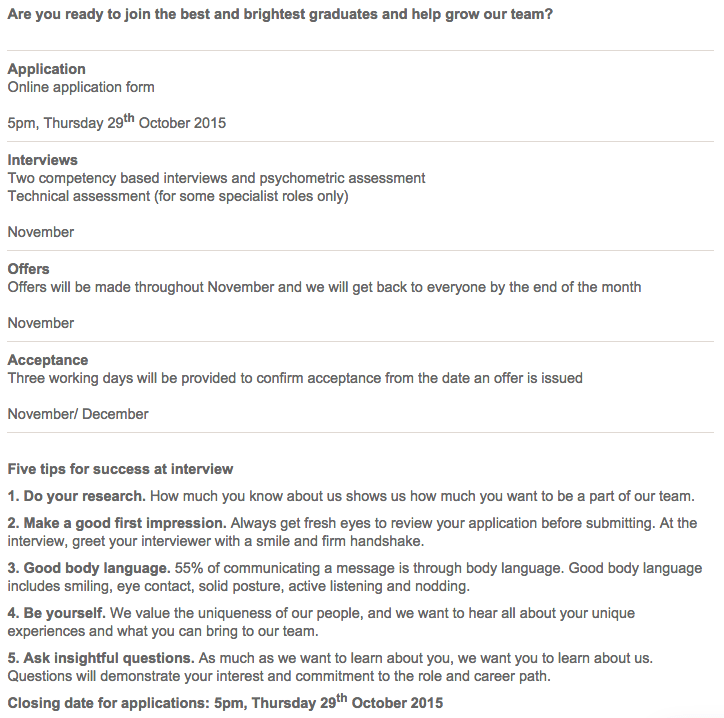
The instructions for application accompanying Glanbia’s application form for their graduate program are clear, comprehensive and easy to assess. They provide any interested candidate with a clear timeline of the company’s application process including the closing date for application, how and when interviews will take place, when offers will be made, and how long successful applicants have to accept their offers:
- Provide genuine feedback
According to Denni Oravec (former director of the NAM Candidate Experience Awards Program), the companies that consistently win Candidate Experience Awards share a particular quality – ensuring that their candidates always receive some kind of feedback and are not just left hanging. Even if it’s only a quick email to let applicants know they’re no longer being considered for a position, she notes, this can be incredibly impactful to candidates. Oh, and don’t be afraid to give negative feedback. In her blog, Kate Reilly reminds recruiters that they should never be afraid to give candidates honest feedback.
Bottom line: treat your candidates as you would like to be treated.
3. Listen to the Social Conversations Being Had About Your Company
“to both understand and shape your brand perception, you have to be a part of those conversations where they’re happening,” say the folks at AddThis.com. Which is why it’s so important for every recruiter to know what people are saying about their company online. And to understand what they’re saying, you need to monitor and listen to people’s conversations.
Now, while you can manually search social networks, forums and online review sites for mentions of your company, it can be exceptionally time-consuming! Which is why we advocate the use of purpose-built social media monitoring tools.
Tools like Social Mention, Talkwalker Alerts, and Mention are time-savers that take the hassle out of monitoring. Many of them are notification systems that allow you to act when you see alerts, and best of all, most of these platforms have a real-time search component. Our favorites (and the social listening tools we currently employ at Social Talent) are Hootsuite and Tweetdeck.
- Hootsuite – The free version of Hootsuite allows you to monitor three social network streams (we monitor LinkedIn and Facebook), while premium paid plans give you the opportunity to listen to conversations happening beyond social media, on blogs, forums and news sites.
- TweetDeck – Free and owned by Twitter, TweetDeck allows you to create side-by-side streams of Twitter mentions, lists, and discussions. We use it to monitor Twitter and in particular; @SocialTalent, #socialtalent, #SourceCon and @soctalentjobs.
Now that you know what potential candidates and customers are saying about your brand, it’s up to you to answer questions, provide information, and send on helpful links. Get involved in the conversation. Remember that even if you respond to just a handful of LinkedIn updates/comments, Facebook posts/comments or tweets initially, you’re building relationships and brand awareness—not just with your followers, but with your followers’ followers as well.
Bottom line: be aware of what people are saying about your company and get involved in the conversation.
Check out the original article on the Social Talent Blog.