While skimming the news earlier today, a particular quote from an article caught my attention and set off a few alarm bells. I quote…
More than half of business owners are 55 years or older, according to the U.S. Census Bureau’s Annual Business Survey. With the youngest Baby Boomers set to reach retirement age in 2030, it’s clear small business ownership will undergo a major transition. The Exit Planning Institute found in a recent study that 75% of business owners would like to exit their businesses within the next 10 years.
“There’s a silver tsunami coming,” said Renee Wiatt, a research specialist with the North Central Regional Center for Rural Development at Purdue University. “There’s basically going to be this mass exodus of that baby boomer age who are going to all be retiring in the next five to 10 years.”
In addition to that quote, the article featured a rather foreboding chart, as shown below.
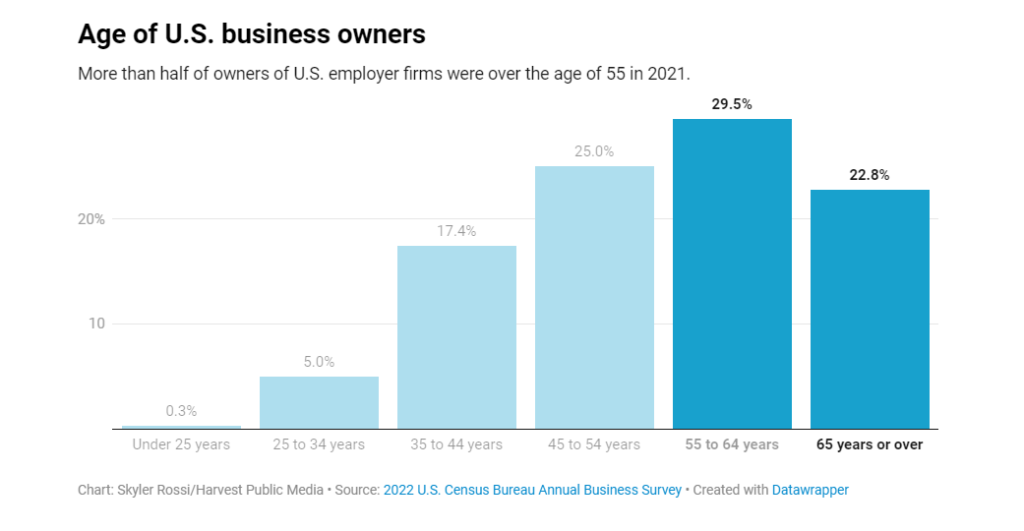
The article delves into the impact on rural America, but I viewed it as a microcosm of the entire U.S. workforce. Consider these stats…
- 99.9% of all businesses in the United States are classified as small businesses, according to the Small Business Administration (SBA) . [source 1, source 2]
- Of employer firms (businesses with employees):
- 99.7% have fewer than 500 employees
- 98.1% have fewer than 100 employees
- 89.0% have fewer than 20 employees
- 78.5% have fewer than 10 employees
- When including both employer and non-employer businesses, 98.0% have fewer than 20 employees and 96.0% have fewer than 10 employees. [Source]
- Out of approximately 32.6 million total businesses in the U.S., only 20,868 had 500 or more employees [Source]
- Small businesses employ 46.8% of private sector employees [Source]
If the majority of businesses are small businesses and the majority of business owners are retiring and/or selling their businesses, how does that affect the talent landscape? Let me count the ways…
Impact on Talent Landscape
- Increased Demand for Leadership and Management Skills
As many small businesses undergo ownership transitions, there will be a heightened demand for individuals with strong leadership and management skills to take over these businesses. Successors will need to possess not only the operational know-how but also the strategic vision to sustain and grow the businesses (International Labour Organization) (Deloitte United States).
- Opportunities for Entrepreneurship
This wave of retirements and business sales opens up substantial opportunities for aspiring entrepreneurs. Many potential buyers, including younger professionals and employees within these companies, may seize the chance to own and operate a business, fostering a new generation of business owners (ADP Media Center).
- Knowledge Transfer and Retention
One of the critical challenges will be ensuring the transfer and retention of institutional knowledge. As seasoned business owners retire, there is a risk of losing valuable insights and expertise. Implementing mentorship and succession planning programs will be essential to mitigate this knowledge gap (Deloitte United States) (ADP Media Center).
- Workforce Stability and Job Security
Employees in small businesses facing ownership transitions might experience uncertainty regarding job security and organizational stability. Effective communication and clear transition plans are crucial to maintain morale and retain talent during these periods of change (Deloitte United States).
- Shift in Business Culture
New owners often bring fresh perspectives and may implement changes in company culture, policies, and operational practices. This can lead to a shift in workplace dynamics, which could either positively or negatively affect employee satisfaction and productivity depending on how well these changes are managed (ADP Media Center)..
And that brings us to an obvious conclusion: in the not-too-distant future, there will be an increased demand for skilled talent. Sourcers, prepare yourselves to find…
- Leadership and Management Roles
With many small business owners retiring, there will be a surge in demand for skilled leaders and managers to take over these roles. Passive candidates, who are often more experienced and already employed, will be a critical target to fill these senior positions due to their expertise and established track records (International Labour Organization) (Deloitte United States) (ADP Media Center).
- Specialized Skills and Knowledge
Many small businesses require specialized skills that are not easily found among active job seekers. Passive candidates, who are not actively looking for a job but possess niche skills and industry knowledge, will become essential to fill these gaps. This need is particularly acute in sectors like technology, healthcare, and finance(International Labour Organization) (ADP Media Center).
This is good news for those concerned about our industry.
The better news is that the urgency to fill critical roles will compel companies to embrace a more proactive approach in their talent acquisition strategies. This means consistently building relationships with potential candidates, even when there are no immediate vacancies, to ensure a steady pipeline of qualified talent. In other words, the days of merely reacting to job requisitions will (finally) come to an end, and companies with sourcing organizations will have to ditch the “take my order, please” mentality.
As enticing as this shift might sound to many sourcers, it’s a double-edged sword. To attract passive candidates, personalized outreach will be more crucial than ever. How personalized? Think AI-powered job matching—platforms like LinkedIn and Indeed use AI to analyze a candidate’s profile, work history, skills, and interests to suggest job openings that match their unique qualifications and career aspirations. These recommendations are continuously refined based on user interactions and feedback. Then there’s adaptive web pages—career pages on company websites can dynamically change content based on the visitor’s profile, such as their job search history, geographic location, and previously viewed positions. This might include personalized job listings, employee testimonials from similar backgrounds, and targeted calls to action. And let’s not forget predictive analytics—using behavioral assessments and predictive analytics, recruiters can gain deeper insights into a candidate’s personality, work style, and cultural fit.
Yet, even with all this technology at your disposal, presuming you have access, there remains a significant need for a high level of emotional intelligence to ensure that a candidate is not only qualified but also interested and available for your opportunity.
In wrapping up, the impending retirement wave of Baby Boomer small business owners is about to revolutionize the talent landscape, presenting a golden opportunity for sourcers. This “silver tsunami” signifies a major shift that will drive the demand for skilled leadership and management through the roof. As sourcers, your role will be more crucial than ever. You’ll need to adopt a proactive approach to identify and engage with passive candidates who possess the expertise and experience to step into these key roles. This era opens up vast opportunities for aspiring entrepreneurs and those ready to take the helm of established businesses. However, it also brings challenges, particularly in ensuring effective knowledge transfer and maintaining workforce stability.
Sourcers must leverage AI-powered tools and personalized outreach strategies to attract and retain top-tier passive candidates. Your ability to build robust candidate pipelines and engage with potential hires even before there are open positions will be essential. The shift towards proactive recruitment is a welcome change, but it also requires a high degree of emotional intelligence to navigate these transitions smoothly. By fostering strong relationships and understanding the unique needs of passive candidates, you can ensure that businesses not only survive but thrive in this new era. Prepare to step up and meet the challenge head-on—your expertise in sourcing will be the linchpin of success in this transformative period.

