There’s one big problem with work at the moment.
And that’s actually getting people together.
Office vacancy rates (that is office space that is available, but which has not yet been filled) hit 18.3% in December 2023 (according to just-published data from the National Office Report 2024), while office occupancy levels in the 10 largest metro areas nationwide still only average around 49.8%.
It’s statistics like these that have caused employers to feel like they’ve got no other choice but to mandate staff return, but as TLNT has recently reported, this hasn’t been going down so well, and is leading to all sorts of employee revolt.
It’s not that employees don’t like each other – in fact most research around Gen Z tends to show that this cohort (which is newest to the world of work), actually ‘wants’ to be with colleagues more, to make social connections, and experience more informal on the job learning.
No, it’s more that so many workers have become accustomed to being at home, so that attempts to command them back are seen as a wrench, especially when staff have long-since adopted working routines to fit around juggling school drop offs and pick-ups, or caring for an elderly relative.
So what’s going to give?
How can employers start to encourage more meaningful employee interaction?
The power of immersion
According to one company, Immersive Gamebox, the answer is about creating a reason to bring staff together and form bonds again.
It’s doing this by providing an avenue for other employers to offer staff the ability to play games with each other.
The company offers AR/VR game experiences at numerous locations across America, where staff can congregate and take part in an immersive experience that allows everyone feel like they’re on the same team again (see below).
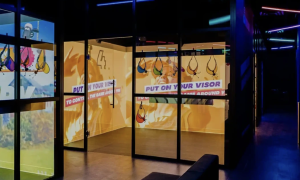
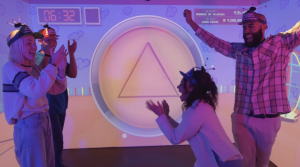
The company was co-founded by Will Dean (MBE), founder of Tough Mudder (the mud-based outdoor obstacle experience), and David Spindler, who launched Tough Mudder Bootcamp, and in a short space of time it has already achieved hitting a milestone 1 million players globally, or 50,555,130 minutes of gameplay.
It specializes in team-bonding experiences, and runs games both co-created with other media owners (such as Angry Birds and the Ghostbusters franchise), or those designed by itself.
Companies want staff to come together
According to its director, Lisa McDowell – who was formerly head of brand strategy and insight at Deliveroo (UK) – demand from corporates to find some form of incentive capable of getting people together is huge.
Speaking exclusively to TLNT, she says: “The notion of bringing people together to share an experience through play is one that more employers are wanting to explore,” she says.
She adds: “Many employees typically see traditional corporate ‘get togethers’ as a form of ‘enforced fun,’ and so engagement in the process just isn’t there to start with.
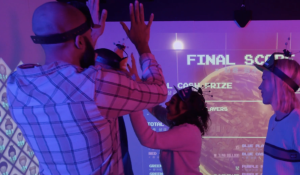
She continues: “But something definitely different happens when employees put on a visor, and start working together in group games.” She adds: “People start to feel silly, but this is a great leveler, and all of a sudden, all elements of people feeling like they have to suck up to the boss are removed.”
There’s an emerging science around the power of creating workplace immersive interactions, and McDowell says its own offering [which has consistently received an average of 4.9 stars out of five across more than 25,000 reviews), really taps into this:
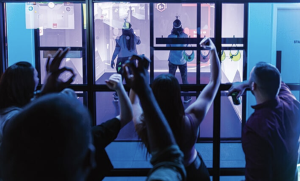
“At the time of the pandemic, when we just launched, and the business was almost instantly put on hold, we could very easily have developed an online offering, where people connect from their at-home computers, and play remotely with each other – just like existing forms of gaming,” she says.
“But the whole point is the personal experience. You can’t recreate the sorts of interactions, and conversations that people have when they’re physically in a room together.”
Although the experiences staff can have are in specific locations, the company already has a touring gamebox, and the idea is for it to be able to take its gamebox experience direct to corporate HQs. There is even tentative plans to look at immersive learning too from an L&D perspective.
“If people feel they have a proper reason to go to an office, they will,” says McDowell.
“Adding this type of experience to an office’s ‘offering’ wouldn’t necessarily seal the return-to-office deal, but it does at least give extra impetus to people to consider why their office is a useful place to be, and what value they get from human connection.”
She concludes: “All the time, we hear from people that offices need to be more ‘playful’ and to re-inject some of that vibe that has been lost. Employees are right now looking for ‘something’ that can help them connect with their workplace again.”
Immersive experiences – the science bit…
- Research by Mary Poffenroth, biopsychology faculty, San Jose State University, published in 2021 found Immersive experiences tend requires participants to make choices or exhibit a set of behaviors which would not normally be not be possible within the confines of reality, and as such boost engagement. She concluded: “What differs with immersive experiences – in the form of virtual worlds or immersive live experiences – is the intentional design and application of actionable, symbolic, and sensory factors.” She added: “Immersive experiences lead to deeper engagement through audience co-creation, evoking emotional responses, active participation, and self-motivated discussions.”
- When it comes to the science of immersive learning, Deloitte has already found that the technology typically allows employees to practice a scenario part by part, or focus on a particular aspect again and again. In the coming years it predicts that “the ability to put people in these immersive simulations will better help both educators and organisations prepare for the future.”
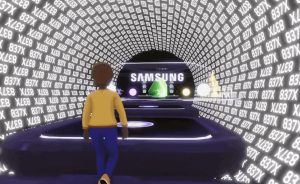
- In 2022, the leading consumer electronics company launched, ‘Samsung 837X’, an immersive digital shopping experience on Decentraland. The activation created a replica of Samsung’s New York flagship store where technology enthusiasts could meet, interact, share ideas, and engage in quests (see below):
- Immersive experiences allow people, irrespective of their backgrounds, to come together for a common purpose and engage in immersive encounters creating a sense of belonging and shared identity. Virtual immersions allow individuals with disabilities like physical, visual, or hearing impairments to experience events, participate in activities and learn without barriers.
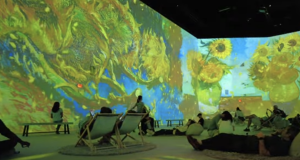
- Immersive digital displays are coming to exhibitions too. Van Gogh’s paintings were recently brought back to life through art immersion, ‘Van Gogh The Immersive Experience,’ with its 360-degree visuals and sounds, has captivated audiences and offers a one-of-a-kind art experience (see below):