Advertisement
HR is Falling Behind in the Race to Transform


Get articles like this
in your inbox
The longest running and most trusted source of information serving talent acquisition professionals.
Advertisement
Related Articles
Editor’s Note: It’s an annual tradition for TLNT to count down the most popular posts of the previous 12 months. We’re reposting each of the top 30 articles through January 2nd. This is No. 6 of the 800 articles posted in 2018. You can find the complete list here.
∼∼∼∼
The future of work is happening right now, and the implications for our workforces are profound.
New career paths, evolving organizational structures and business models, analytics, and digital disruption are trends every HR professional faces. Never has the role of HR leadership been more important in making this transformation happen.
While HR leaders should be in an enviable position, in reality they’re losing the race.
Their organizations are changing faster than they are, putting them even farther behind concludes a voluminous study entitled Global Leadership Forecast 2018 by Development Dimensions International, The Conference Board, and EY.
Business leaders no longer need to be convinced how important talent is – they just need HR to successfully and strategically manage and develop that talent.
In a July 2017 McKinsey Quarterly article, the authors assert that HR needs to “step out of its traditional silo and embrace a strategic role, using talent to drive value rather than just responding passively to the needs of the business.”
This chart 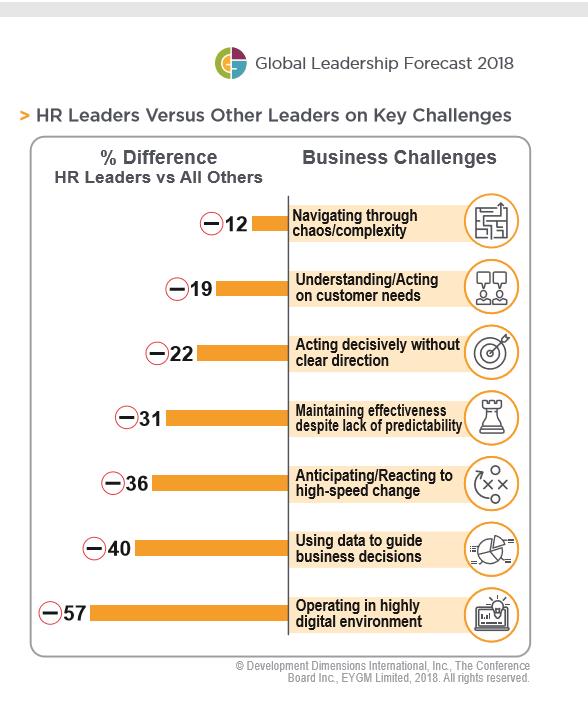 highlights the effectiveness of leaders in executing key business challenges. In every case, HR leaders felt less prepared than their colleagues in other leadership roles.
These results are more than concerning – they could prove fatal to an organization. The business world is experiencing considerable upheaval, yet only one in five HR leaders feel very prepared to handle the top five challenges on the graphic.
Worse yet, the biggest differences are in their perceived effectiveness to operate in a digital environment and use data analytics, despite the increased pressure they’re feeling to do so.
A couple of years ago, the Harvard Business Review devoted an entire issue to the role of HR. The provocative title of the lead article, “Why We Love to Hate HR and What HR Can Do About It,” foreshadows a critical situation. The opening salvo of the article summarized the state of HR: “Recent complaints about the HR function have touched a nerve in a large, sympathetic audience. The most vocal critics say that HR managers focus too much on ‘administrivia’ and lack vision and strategic insight.”
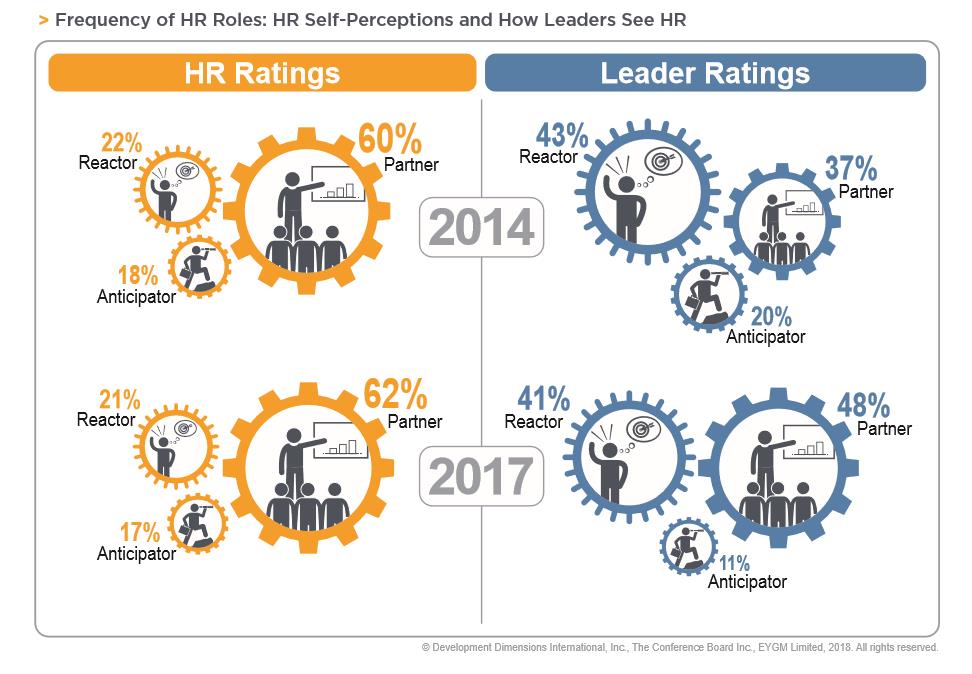
Similarly, one of the mega-trends called out in the Global Leadership Forecast 2018 is “HR is losing its influence.” The report defines three potential roles for HR:
In the past three years the report found HR’s reputation has gotten worse, with more senior leaders now believing that HR is simply a “Reactor” that executes commands rather than an “Anticipator” that develops a people strategy that enables the organization’s business strategy.
As you can see in this graphic, fewer than one in five HR professionals consider themselves Anticipators. And business leaders are less likely to place HR professionals in the Anticipator role – in both 2014 and 2018, business leaders were twice as likely as HR professionals to label them Reactors.
 Anticipators trump partners
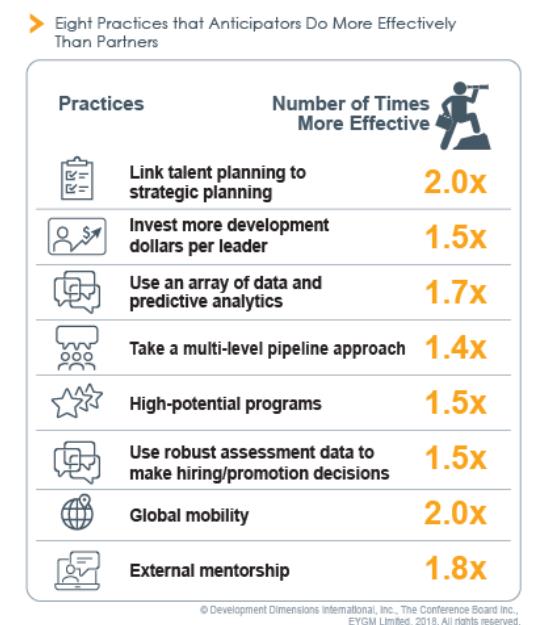
While it may sound counter-intuitive, striving to be a “Partner” to senior leadership may prove less effective and prevent HR from being offered that coveted seat at the executive table. As noted in the chart below, the study found that Anticipators are significantly more effective than Partners in successfully executing these eight business practices.
 So how do you become an anticipator?
The business world has been bombarded with scathing critiques of HR and passionate pleas for the department’s transformation for several years now. While many HR professionals have answered the call and are leading the way as exemplary role models for the enormous potential and impact of a strategically-focused discipline, far too many HR professionals are still unable or unwilling to make the needed changes.
In fairness, while many senior leaders have realized the importance of company culture for organizational success, they’ve thwarted the best intentions of HR to participate more fully by withholding the resources and/or support for them to do so. For the sake of the organization, it’s time for HR and senior executives to finally step up and optimize this critical function… Now!